Target Yield (TY)
ROI Fallacy
Dumping $1.5M to "guarantee" a hit. Disney 2023: 70+ titles removed, $1.5B write-down.
PE Approach
Redlining budgets to hit the same TY with $600k and organic growth hooks.
VC Signal
30% YoY
Adoption beats margin
Capital Efficiency Curve
Values in $k- Budget inflation: A-list casts, heavy VFX
- Diminishing returns on excess capital
- Write-down exposure (Disney 2023)
- High margins, low annual growth
- Unit economics modeled before allocation
- Overhead reduction as primary lever
- Organic growth over marketing spend
- Contingency buffer over budget padding
Strategy
Don't burn meaningful capital on anything with under-modeled unit economics. Fixate on minimizing allocation with respect to TY.
The Tesla / Uber Model
Negative margins are acceptable as long as adoption curves signal a moonshot and unit economics are patchable.
Capital Redlining
Ask: can this project's upside be reached with a rotational cast? Less CGI? A tighter scope? Less A-list?
ROI isn't the most defining metric of profit maximization; it's actually one of the biggest growth fallacies in business. Instead of initial modeling going towards thinking through how the TY (target yield) can be obtained, companies mistakenly dump more than required just to hit returns they could've obtained with way less overhead. A company that has an 80% profit margin each quarter but has growth rates of 1-2% annually isn't a high yield bet, it's a low dividends bet at best. A company that has a -100% profit margin quarterly, but ends the year with a 30% growth rate in customer adoption, is a fragile rocket ship that, if patched up with more robust unit economics, could be a moonshot.
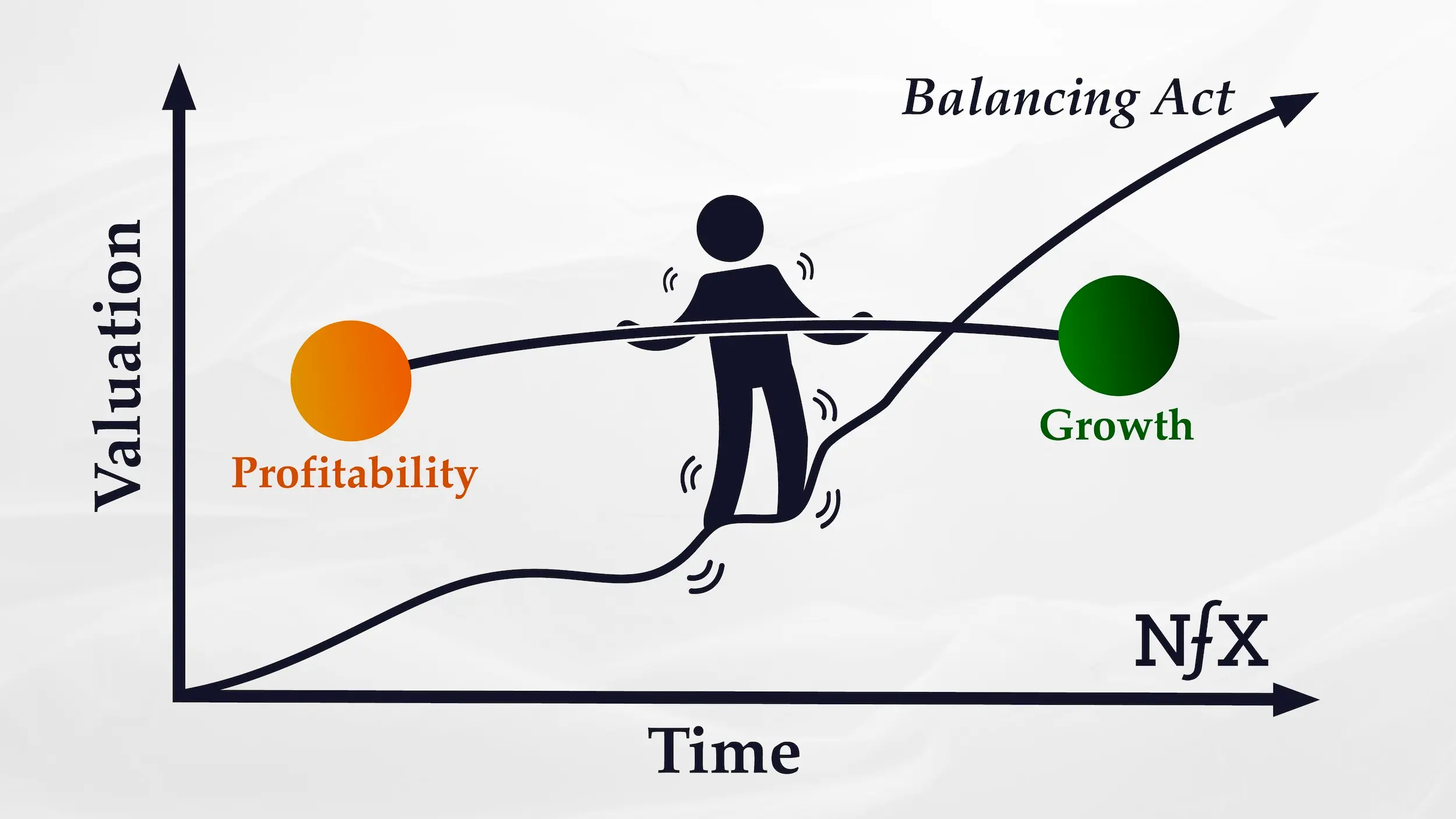
It's no secret that Nasdaq and VCs see it the same way. Uber, Tesla, and Snapchat and many others have remained unprofitable for years, all while user growth and product adoption continued to rise, causing their stock prices to do so as well. But unprofitability doesn't have to be a constant for a growth stage company.
When measuring growth tactics, the emphasis shouldn't be "how much yield will this investment get me," it's what's the least amount I can spend to hit our TY. If companies started optimizing for overhead reduction while doing diligence on fulfilling objectives, there would be significantly less capital waste. In 2023 alone, Disney removed 70+ titles and took a $1.5 billion write-down tied to that content purge.1 In a world where studios start strategizing growth with respect to what I call Profitability Equilibrium, defined as the minimum capital required to reach a specific growth benchmark without breaking unit economics, before making any content purchasing or licensing decisions, they'd evaluate if the projected upside they can get from a show can be obtained with less capital allocated to another show, or with redlines to the show's budget. Less VFX? More organic growth dependence than marketing? Less CGI? Less of an A-list cast, and more of a rotational cast comprised of extras? It's akin to the MVP (minimum viable product) framework most startups deploy. In this case, it's not about optimizing for the least necessary product; it's about optimizing for the least capital necessary to reach TY.

ROI isn't a dead metric that shouldn't be accounted for; its value in isolation is what enables frivolous capital allocation. But in tandem with Profitability Equilibrium, costs and growth can be at optimal levels. The ideal execution can be summed up in one blurb:
Don't burn meaningful capital on anything with undetermined or under-modeled unit economics. While you're doing diligence, fixate on every measure you can take to minimize capital allocation with respect to your TY. If you figure out that the upside you can get from the project, even after your cost optimizations, is unworthwhile, reallocate your resources elsewhere. And never build your profitability equilibrium budget without a buffer baked in for contingencies.
Isaiah Cole, April 2026